The Nebulous Kingdom

Growing externalities

12/31/2013

Comments

 
I grew up in sunny southern California but went to school for a couple years in the colder climes of Chicago.  

One of the first things I noticed about Chicago is that these kind people sure like to honk when driving an automobile.  Not the sort of honking to warn you about something you ought to know, or to flirt with a pretty young thing in a mildly obnoxious way, but the kind of apparently useless honking as they're already making a turn behind you so wouldn't even get the benefit of a behavioral improvement (if you so chose to make one), that leaves you a bit puzzled and disgruntled.  After it happened a few times, I asked someone once about it, a Chicagoan native, and they knowingly said, "Ah, they're just trying to teach you a lesson."

Someone once told me about a study that compared different cities and how long on average it would take a motorist behind another car to honk once the light turned green.  The results were as you would imagine, "nicer" cities had longer average time-to-honk - except in Los Angeles, where they would just drive around you without a honk.

They say it takes a village, but there's a cost to living in small communities where everyone knows each other, knows about each other.  Social order is attained through the intangible but colossal power of relationships, of shame, and the need we have for human ties.  It hurts us to be shamed.  When those nice Chicagoans were honking at me, they were essentially giving me feedback - "You screwed up" - and backing it up with the public social shaming of a good toot of the horn.  And it worked - it made me feel bad.  This power can create both great evil as well as the realization and recognition of that evil.

What happens when externalities grow, when general consensus is that we can't afford for people to exercise individual freedoms when it affects others, sometimes many others.  What happens in a world of massive externalities?

"The intertwining of the global financial system is perhaps just an example and a metaphor for an even larger trend towards interconnection and increasing externalities.  After all, as we live more closely in urban mega-cities and interact more regularly over the internet and web-enabled mobile devices, it makes sense that both positive and negative externalities – that is, the impact of transactions on parties outside those transactions – would increase.  In this world, the price mechanism fails more often.  Our models fail more often.  In this world of increasing uncertainty, where positive verification isn’t to be had, the positivist view seems less useful.  This is important - once externalities gets to a certain level, it seems inevitable that our society will try to gain greater control of its constituents, to avoid inflicting the social cost of negative externalities or incent behavior which results in positive externalities.  This points to a trend towards greater regulation and loss of individual liberty."

Everyone's entitled to their own opinion, but I'm seeing more instances of criticism these days where the language being used is a moral vocabulary and backed with the institutional weight of risk-averse corporations and policymakers.  It used to be that we would commonly see this from the political and religious right but now the dynamic is playing out on both ends of the spectrum - from the accusations of glorifying excess in the movie "Wolf of Wall Street" to the demonizing of individuals with sincerely held views on controversial topics such as abortion and gay marriage, or those who are just making art or attempting humor.  We're not just shaming people anymore with a toot of the horn, we're backing it with the consequences of lost jobs, terminated contracts, and fewer future opportunities as well as a permanent record of the public humiliation.  It's the stocks and pillory again.

Everyone's entitled to their own opinion.  But when their opinion, tied to their identity and integrated into one person's moral outlook, is backed by the power-equivalent of the state, it becomes a problem.  

Today will take care of itself.  I worry about the future though.  I can envision one path, a world where we have fewer degrees of freedom, where it's grayer and sadder, and we don't even notice the liberties we've lost.  I'd like to take a different one, a brighter path where we build trust through information, teach through storytelling, and leave individuals their freedom, humanity and opportunities to chase their dreams and make their mistakes.  

And maybe, sometimes, drive around them with a smile and wave instead of a honk.

Comments

Being a Grownup

11/25/2013

Comments

 
I used to be one of those kids who did extra credit to get straight A-pluses and actually tried to win the science fair.  As I grew older and went to college, I wasn't always responsible but I did always know that I wanted to work.  Before I turned 22, I had managed a team of 50-year-olds, met some serious operational metrics, and been part of a firing decision.  A decade later, I own a home and 2 graduate degrees, and still, secretly, I've never really felt completely grown-up.  I still do things like fly kites, float paper planes out a second-story window at a wheelchair-bound friend below, drop my mike and run during a bad karaoke performance, acquire a suite of crabbing gear with very poor ROI, jump off a cliff achieving a badly bruised tailbone.

When I was younger and looked at people my age now, they seemed so old.  They had this seriousness, this gravitas, about them that I can't but help think now was either a complete facade or the result of an extremely dull inner life.  Now that I'm at the age of being grownup, I look around and all the people who seem like big deals are almost never the ones who are.

So I have to ask myself - what does it mean to be a grownup?  Is it about responsibility, accountability, gravity, maturity, all the words normally associated with adulthood.  The times I've felt most grownup:
  • Standing up and defending someone on my team
  • Changing the tone and tenor of a conversation going awry
  • Reaching out to individuals who look lost in a social setting
  • Speaking up in a new group or high-powered setting 
  • Telling the truth when it's hard 
  • Saying I'm sorry when I don't have to
  • Calling my mom even when I'm busy
  • Stepping out of the rat race to go back to school
  • Going to conferences where I don't know anyone
  • Treating powerful people like they're human beings
  • Backing off an argument for the right reasons
  • Rising above the group dynamics and telling a better story
  • Taking a personal risk to help someone junior or lower-status
  • Being my very self in every situation
  • Sharing the lessons learned from my mistakes
  • Initiating the first conversation
  • Carving out time by saying 'no'
  • Giving genuine compliments based on real noticings
  • Saying "I love you" first
  • Casting out shame from my life
  • Responding well and fairly to the anger of others 
  • Being unadulteratedly happy for those who achieve what I want
  • Changing the small talk
  • Asking for help

They seem to be more related to choice, risk-taking, empathy, being human, understanding and owning your emotions, questioning the first premise, changing the working premise.  It's about making that mental pivot, taking that left turn, and owning the bringing along of those around you.  It seems like being a grownup is very close to the essence of being human - being the deus ex machina of our own lives.  It's not something you can do all the time, you have to constantly work it, and it's always an achievement when you get there.  This life thing never seems to get easy, does it.
Comments

More for Same

9/6/2013

Comments

 
I read this analysis on what makes for an exceptional company, driven by data on thousands of companies over 45 years:  http://dupress.com/articles/pulling-ahead-versus-catching-up-tradeoffs-and-the-quest-for-exceptional-profitability/?coll=3655

The short (and somewhat obvious) answer - better "performance." Not lower prices. Performance can be sustainably differentiated over time. Price is denominated in dollars, the ultimate commodity.  The only way to differentiate on price is to make it lower, and all that's required to overtake you is a tweak in the cost structure and a swipe of then pen.  I'm vastly oversimplifying to point of idiocy, but in essence, in the debate between "more for more" and "less for less", the answer seems to be "more at some price point that allows you to re-invest in even more."

What should that price point be?  In a networked world, holding revenue constant, more users at a lower price point is better than fewer users at a higher price point.  Unless it's a true luxury good whose few users include the likes of Oprah Winfrey, Kanye West and Barack Obama.  Because it's better to have more free-agent ambassadors and reference points - it enables free credible marketing and PR, and potentially an ecosystem of hackers, developers, spinoffs, and feedback providers that can make your offering more valuable over time.  As Brad Fitzpatrick, founder of LiveJournal once said, "Having users is the key to getting contributors. More users find more bugs and find more use cases."

I would posit that often the answer is "more for about the same".  "More for about the same" is a dominant position from a price standpoint.  It is net better than "more for less" and enables more network- and ecosystem-driven opportunities than "more for a lot more".

The critical questions become - "What can your cost structure support, and how much cash flow do you need to re-invest?"  "More for about the same" might be "more for slightly more", but it still comes down to the affordances of your cost structure (or what your cost structure could be).  Apple, for instance, has a shockingly better cost structure than its competitors, which enables it to make money from both ends - by charging higher prices as a luxury good and by constraining costs.  And even Apple is finally dropping the price on their iPhone:  http://finance.yahoo.com/blogs/daily-ticker/apple-cheaper-iphone-low-150045949.html

Perhaps, rather than a sign of weakness, it's a sign of greater dominance to come.  At the end of the day, it will depend on what they're going to do with their pile of cash.
Comments

A question: What makes "in-person" so different?

9/6/2013

Comments

 
I have a job where frequent travel is a prerequisite, yet travel is so astoundingly wasteful. You're constantly in hectic transit, standing in line, taking off jackets, spending money on planes and taxis - it's substantially expensive for you to be dramatically less productive. And god forbid something goes wrong - missed flight, bad weather, lost luggage etc. Then you're just screwed.

So I've been thinking a lot about why I have to travel, whether we take it for granted the value of "in-person", and if there's an opportunity to close the gap, push out the performance frontier.

I recently saw in my Facebook feed a debate on whether investors should hear pitches over Google Hangout or some other virtual means. One of the responses was super interesting - in essence, he said his team found out that the remote team thought the presenting startup founder was significantly more arrogant than the local team. He recommended virtual pitches only if you already knew the team.

Why? Why? What makes that difference? Why does it matter that you're in the room?

Is it that we don't catch the facial nuances so are left to interpret only the more dramatic gestures and expressions we do see?

Is it that we can't smell their pheromones and emotion indicators, and therefore are missing important data in our analysis?

Is it that we haven't shaken their hands and felt a sense of kinship from the ritual and biochemical stimuli resulting from skin touching skin? 

Is it that we can't see their faces at a scale that our brains interpret as human, and therefore feel less empathy?

I could go on and on. We know that trust is about information, and that it's very difficult to build trust without meeting someone at least once. There's something in that live interaction, that if we dissected it and understood it, maybe we could build technology that did more than just solved the problem of seeing the same slides and hearing the same voices - or even seeing the same faces and co-authoring the same document - to create an experience where I feel like I'm in the same room as you.  So I never have to get on a plane unless it's going somewhere with ocean and white sand.


Comments

Designers, strategists and leaders - just arrogant enough.

8/28/2013

Comments

 
As a post-Ballmer world looms ahead, I take a moment to ponder the immense challenge that lies ahead for his successor.  I am reminded of something a colleague once told me, when I remarked on his sizable innovation budget, "Don't envy me. With cash comes expectations."  

It's true.  That's why baby startups (the ones that you've heard of, anyway) always seem to over-deliver, and lumbering enterprises often seem to disappoint.  Relative to baby startups, big companies have brand recognition, cash on the books, pools of talent, and partners clamoring to work with them.  They are the equivalent of the wealthy Anglo-Saxon male Etonite and Harvardian descended from the time of the Mayflower, outlandishly advantaged (though invisibly constrained in other ways).  Given these assets, moderate success usually carries the odor of failure.

Microsoft is wildly successful.  Not "was", but "is".  $100B+ in cash and current assets on the books, according to their last annual filing, $78B in revenue, $27B in operating income, $22B in net income.  

I'm sure they wish their stock price was higher and less volatile, but generally any sane person would conclude they're not going bankrupt any time soon.  They have Office, Windows, Surface, Xbox, and above all, a giant ogre's foot wedged into every nook and cranny of the enterprise, one that won't be soon unseated.

But shhhh watch out, they're comin' to storm the castle.  Who's they?  Everyone.  The enterprise is the next gold rush.  The last one, in the consumer space, will soon become saturated.  The reluctant enterprise who's been like a wallflower swaying on the sidelines will be lured into the dance.

Ballmer's successor will have to get Microsoft to dance.  This is the tough bit - how to be just arrogant enough.  Bold, swashbuckling and visionary on one hand, enough to get people to want to dance with you, while being warm-eyed, trustworthy and ready to learn, so the lady will come.  

It's the marker of great designers, strategists and leaders - the ability to be just arrogant enough.  Someone needs to hold the complete vision in his head, with the courage of his (or her) conviction as the market beats him down, the analysts call him a dunce, investments get thrown away, and whole divisions get fired..  That same person needs to be able to evolve that vision, humbly - with the input of his team, as the landscape shifts under his feet, in combinatorial iterations and learning through market tests and failures.

I don't envy Ballmer's successor.  It does sound like some fun though.
Comments

Another way in which trust makes everything better

8/22/2013

Comments

 
I saw this article in the Economist...  http://www.economist.com/news/business/21583592-businesspeople-would-be-better-if-they-did-less-and-thought-more-praise-laziness

...particularly this quote:  "Yet the biggest problem in the business world is not too little but too much—too many distractions and interruptions, too many things done for the sake of form, and altogether too much busy-ness. The Dutch seem to believe that an excess of meetings is the biggest devourer of time: they talk of vergaderziekte, “meeting sickness”. However, a study last year by the McKinsey Global Institute suggests that it is e-mails: it found that highly skilled office workers spend more than a quarter of each working day writing and responding to them.

Which of these banes of modern business life is worse remains open to debate. But what is clear is that office workers are on a treadmill of pointless activity. Managers allow meetings to drag on for hours. Workers generate e-mails because it requires little effort and no thought. An entire management industry exists to spin the treadmill ever faster."

And it occurred to me that the coordination of human activity is both at the center of our ills, and the potential source of massive gains - where the next golden age will come from.  All these activities - consensus-building meetings, alignment calls, opening salvos, small talk, closing transitions, live face-to-face sit-downs for projects, multiple email drafts, unwarranted cc-ing - most of them are not about communication.  Most are coordination costs related to relationship- and trust-building.  No wonder big companies move so slowly - all real risks are experienced at the individual level, and social and relationship risk is ever-present in very large groups and costly in effect.

If every person I interacted with was completely trustworthy, and I trusted completely every person I came into touch with, from both a competence and benevolence standpoint, I would either be dramatically more productive - or I would have dramatically more free time during each day.  To cook, to bicycle, to read, sleep in until I'm rested, maybe on a beach.  "For work, if you love that best.  For education, for beauty, for art, for pleasure. For mumblety-peg if that's where your heart lies."

This is the cost of low levels of trust.  What are the answers?  I don't have them all but here are a sample:
  • Surround yourself with people you trust (e.g. family, friends, close colleagues) and make them keep liking you and the situation enough to stay
  • Figure out how to trust the people you're surrounded by (e.g. get to know them over drinks, meet their friends and family, learn about their background and context)
  • Try to move away from people you fundamentally are unable to trust (e.g. change teams, quit your job)
  • Become more trustworthy yourself (e.g. actively pursue integrity, internal consistency and high levels of empathy as values)
  • Initiate trust-building protocols that accelerate the perception of you as trustworthy (e.g. empathy-driven actions without any benefit in return, blunt honest opening sequences in new relationships, showing that you trust them by taking a risk on them)

The reward - fewer calls, fewer meetings, more time in your day spent on work that requires judgment and creativity, more time spent doing the things you love with the people you love.
Comments

What will become of art?  II

5/9/2013

Comments

 
A couple years I wrote about what would become of art, and made the argument that after art becomes technically easier because of technology, "what remains and what we call art will fall into three main channels:  (1) art as great stories, (2) art as the journey of the artist in their time, and (3) art as an epic endeavor."

I still believe so but I was missing a couple of arenas.

First, art that remains technically challenging but requires different sorts of capabilities, such as Sarah Jarrett's art.  This sort of artist will need to be able to manipulate apps, mix photographs with filters, draw in 3-D, tap into the crowd - and still be able to surface a vision that calls forth from all of us something that is wordless but felt.

Then, there is the art that is deeply personal, almost individual.  While art has always been personal to the artist, technology has created a situation where we are all able to create this sort of art, even those of us without a claim to the title.  I can take a photo of my mother, an aged torn scrap with yellowed edges, from her first years in this country when she was lovely and full of hope, and make something beautiful from it.  I can put that transformed photo on my wall and even if it's untutored and rough, it will always remind me of the passing of time, of joyous memories, and the greatest love I might ever experience in my entire life.

Picture
Comments

Mashing up think and do - the pendulum swings back

4/22/2013

Comments

 
I saw this great article on the shift of General Electric's manufacturing back to the US:  http://www.theatlantic.com/magazine/archive/2012/12/the-insourcing-boom/309166/?single_page=true

And "a funny thing happened to the GeoSpring on the way from the cheap Chinese factory to the expensive Kentucky factory: The material cost went down. The labor required to make it went down. The quality went up. Even the energy efficiency went up."

"What we had wrong was the idea that anybody can screw together a dishwasher,” says Lenzi. “We thought, ‘We’ll do the engineering, we’ll do the marketing, and the manufacturing becomes a black box.’ But there is an inherent understanding that moves out when you move the manufacturing out. And you never get it back.”

"It happens slowly. When you first send the toaster or the water heater to an overseas factory, you know how it’s made. You were just making it—yesterday, last month, last quarter. But as products change, as technologies evolve, as years pass, as you change factories to chase lower labor costs, the gap between the people imagining the products and the people making them becomes as wide as the Pacific."


Those of us who have been living in the SF Bay Area and following Google's serendipity-fostering HR and infrastructure decisions, and John Hagel / The Center for the Edge's thinking on the "Power of Pull" and the importance of place, will not be surprised to hear that the corporation is finally evolving in the same direction.

But US firms were not wrong to send their commodity assembly and manufacturing offshore in the previous cycle.  The discrepancy in labor costs between the US and China at the contemporaneous labor productivity levels was too dramatic to ignore.  Companies who flouted the offshoring trend went out of business.  But economics change, the bases of competititon shift, labor costs converge, and products transform.

And now we're moving back to a place where organizational learning and agility drive competitive advantage; where the ability of an organization to build a knowledge-sharing infrastructure, invest in long-term relationships, attract super-talent at all levels, and generate broad-based trust are core enablers; and -- somewhat controversially, the people who think need to be the people that do.

We like to put people into boxes - the executive, the creative, the engineer, the marketing guy.  "It's not fair to ask a project manager to come up with the ideas."  "We want to make sure they're successful."  "We need to bring someone in from the outside - an agency type."  "We don't have that skillset here."  "He writes books, he's not in the market knocking on doors."  These statements may all be true at the time they're said, but they're also used to pigeonhole people - because it's cognitively easier and cheaper to think of turn people into caricatures rather than think of them as whole, complex persons with myriad capacities that often go untapped.  We use the term "resources" to refer to people, because managers are trained to optimize among pools of resources - just like in videogames.
 
But people are not commodities like coal and oil, or base structures and drones.  Someone can be both engineer and artist, creative and project manager, and excel at both.  There's no natural tradeoff, the tradeoff here is one of time - how do they spend their time?  What do they learn to master?  And how does that mastery compete in the marketplace?

It comes down to the pendulum swing of specialization vs. integration.  Just like with General Electric, there is no timelessly right or wrong answer.  The pendulum will continue to swing back and forth, and firms will continue to race to stay ahead of it.

And the argument now, in this time, is that knowledge-sharing, connectedness, being in the same near-physical place as your colleagues, mashing up ideas on the whiteboard, speaking the same language, sanding away any fear or friction around surfacing new thoughts, sharing similar norms and values, feeling like you're in a fast-paced relay flash-mob race of learning - and that the people who think are the same folks as those who do - these are the current sources of competitive advantage.  Just like the gap widened over time between the "designers" and the "workers" in General Electric,  the gap will tend to widen over time across all distributed knowledge-based endeavors that don't design their interactions in a high-protocol fashion.  There's a reason why Marissa Mayer enacted the controversial decision to limit working from home at Yahoo.
  
It's a sea change for creatives who have gotten used to throwing ideas out for someone else to implement, for authors who have gotten accustomed to aggregating the labwork of others, for "thought leaders" who have achieved fame by pointing out patterns and telling some good stories, for consultants who only do strategy and leave execution to the "stakeholders", for MBAs who want to launch a tech startup without a technical co-founder or knowing how to code, for managers who see talented staff as resources and foster a fear-driven and fiercely competitive environment, for anyone that doesn't want to risk themselves in the field of action.

I spent a lot of time asking questions and listening over my career, and it's been a humbling journey to find out how little I know about anything.  The ins and outs of wastewater management, the nuances of the precision valve industry, the scale of airplane manufacturing, the complexity of our military-industrial complex, what it takes to run an Amazon-like distribution operation, the challenges of picking and packing orders for delivery, the incredible and inspirational talent in India, the back-and-forth of app design and development - you have to roll up your sleeves and get your hands dirty to really know about these things.  You can't just read a blog and take a site tour.  For every inch I progress my knowledge in these areas, I uncover a football field of terrain.  There are so few experts in this world, I sometimes wonder how we keep this civilization together at all.  I always laugh when I hear the term "due diligence."

Everyone with just a hammer will find that the nails are turning into Rubik's cubes that are protagonists in a role-playing game where the rules of engagement are the dynamically derived outcomes of a different role-playing game enacted a world away. 

Can we ever win?  Maybe that's the wrong question.  From the children's book Cheaper by the Dozen, after the authors' father and time-saving operations expert Frank Gilbert had died of a heart attack:

"Someone once asked Dad:
“But what do you want to save time for? What
are you going to do with
it?”


“For work, if you love that best,” said Dad. “For education, for beauty, for art, for pleasure.” He looked over the top of his pince-nez, “For mumblety-peg if that's where your heart lies."
Comments

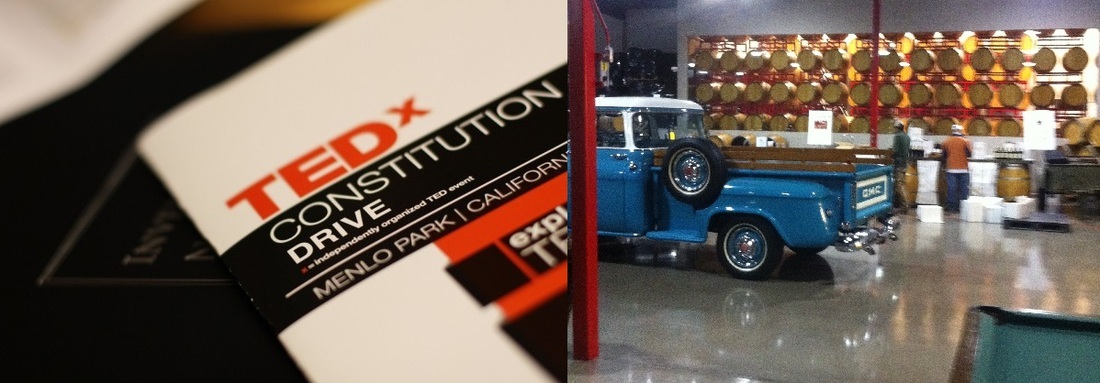
TEDxConstitutionDrive - Menlo Park, CA - May 4.  "On Time"

4/15/2013

Comments

 
Picture
In the spirit of "ideas worth spreading," TED has created TEDx. TEDx is a program of local, self-organized events that bring people together to share a TED-like experience. Our event is called TEDxConstitutionDrive, where x = independently organized TED event. At TEDxConstitutionDrive, TEDTalks video and live speakers will combine to spark deep discussion and connection in a small group. The TED Conference provides general guidance for the TEDx program, but individual TEDx events, including ours, are self-organized.

Learn about previous years' events at:
http://www.tedxconstitutiondrive.com/
http://tedx.posterous.com/tedxconstitutiondrive-2010-an-intimate-event

The themes of previous years have been TRUST [2010] and IDENTITY [2012], respectively. This year will be TIME!  We're excited about the possibilities of this theme to explore how human beings experience their time, the science of it, how we manage it (and how it manages us sometimes), and stories of the stuff of our lives. Again, we're gathering amazing speakers to talk on this topic from diverse angles - -

Isa and Ana Stenzel
cystic fibrosis / lung transplant survivors
“The Power of Two”

Michael Santos
writer, consultant and former inmate
“9,135 Days In Prison”

Cello Joe
beatboxing cellist & international bicycle-touring vagabond troubadour
“Cello Joe: Cello & Beatbox”

Sam Lessin
director of product, Facebook
“bending time: what happens when identity and technology mix"

Mort Grosser
venture investor and inventor of human-powered airplanes
“The Time of Your Life”

Red Hot Chachkas
new American klezmer band
“Klezmer Music - Tradition & Future”

Lisa Solomon
professor of design strategy, CCA
“Designing Time: Meaning, not Management”

Chuck Darrah
anthropology department chair, co-founder of the Silicon Valley Cultures Project & the Human Aspirations and Design Laboratory (HADLab)
“Technology and Time”

Blaine Dehmlow
TechShop San Francisco
“Making Time for Making Time”

Abbas Milani
director of Iranian studies, Stanford
“The Trauma of Time in Modern Iran”

Kelly McVicker
founder, McVicker Pickles
“Pickling & The Art of Time Travel”

Jonathan Ly
fitness trainer, Body Mechanix
“Fitness & Making the Most of Your Time”

Buff Giurlani
entrepreneur and founder of the unique classic car warehouse and winery Auto-Vino
“Cars & Wine – Getting Better Over Time”

We try to make this an intimate and low-key event where people who are deeply interested in the topic can engage with each other on a personal level. Please come with an open mind and a sincere desire to connect with the ideas and the other attendees.

Our venue is the phenomenal classic car warehouse and winery (yes, both!) Auto-Vino. If you love one-of-a-kind fabulous cars and wine-tasting, in addition to great ideas and people, this is the TEDx for you. After we finish the speaker sessions at 4pm, we will transition to the winery counter for an optional wine-tasting flight (included in your ticket).

TEDxConstitutionDrive is a non-profit program fiscally sponsored by Philanthro Productions, Inc., a 501(c)(3) non-profit organization – Tax ID: 20-8695723.  Ticket fees will go towards event planning and speaker expenses. Fees cover speaker sessions, snacks, lunch and one wine-tasting flight.

About TED

TED is a nonprofit organization devoted to Ideas Worth Spreading. Started as a four-day conference in California 25 years ago, TED has grown to support those world-changing ideas with multiple initiatives. The annual TED Conference invites the world's leading thinkers and doers to speak for 18 minutes. Their talks are then made available, free, at TED.com. TED speakers have included Bill Gates, Al Gore, Jane Goodall, Elizabeth Gilbert, Sir Richard Branson, Nandan Nilekani,Philippe Starck, Ngozi Okonjo-Iweala, Isabel Allende and UK Prime Minister Gordon Brown. The annual TED Conference takes place in Long Beach, California, with simulcast in Palm Springs; TEDGlobal is held each year in Oxford, UK. TED's media initiatives include TED.com, where new TEDTalks are posted daily, and the Open Translation Project, which provides subtitles and interactive transcripts as well as the ability for any TEDTalk to be translated by volunteers worldwide. TED has established the annual TED Prize, where exceptional individuals with a wish to change the world are given the opportunity to put their wishes into action; TEDx, which offers individuals or groups a way to host local, self-organized events around the world, and the TEDFellows program,helping world-changing innovators from around the globe to become part of the TED community and, with its help, amplify the impact of their remarkable projects and activities.

Follow TED on Twitter at twitter.com/TEDTalks, or on Facebook at facebook.com/TED

Comments

Asshole CEOs

2/27/2013

Comments

 
I've been thinking about leadership lately, and the stark contrast between Jim Collins' humble "Level 5 leader" and the success of Steve Jobs.  And while Collins' perspective has personal resonance for me, I have to conclude that there's more nuance here.

Here's a data point.  When I did my dissertation, I found that if you exhibit a low level of responsiveness in an organization, this negatively impacted the degree to which people trusted you - except if you were more senior.  If you're more senior, they assume you're busy rather than being a prick.  Somewhat unfortunately, people with lower status tend to cut people of higher status a lot of slack.   

Also - and follow me here - trust in leadership is based on competence as well as benevolence, people gauge competence by the maximum instance experienced rather than the median, their memory is more vivid when cortisol (stress) levels are higher, and abrasiveness can undoubtedly be effective in the short run in driving outcomes.  In short, being an asshole can be impressively productive and memorably so.

I've found that leaders who are assholes but supremely competent or brilliant tend to be loved by their staff.  Phrases used include "Challenging but rewarding", "The cost of genius", "It's not personal", "I've learned so much", and "I wouldn't take back the experience for the world."  There's a belief that the leaders wouldn't have accomplished so much if they didn't knock down some walls.  And A-players seek steep learning curves and development opportunities above all.

So does that lead us to the somewhat repelling notion that being an asshole is okay if you're really good at what you do?  Well, here's the rub:  This is true only if you're really that good, if you're right all the time, and the best strategy over the time horizon in scope is really to knock down walls rather than build bridges.  Maybe Steve Jobs was, but it's a rare enough confluence that I wouldn't put my eggs in that basket.

Comments
<<Previous
Forward>>
    Picture

    Author

    I'm interested in uncertainty, time, trust, consistency, strategy, economics, empathy, philosophy, education, technology, story-telling, and fractals.
    Contact

    Archives

    May 2016
    October 2015
    September 2015
    June 2015
    January 2015
    March 2014
    February 2014
    January 2014
    December 2013
    November 2013
    September 2013
    August 2013
    May 2013
    April 2013
    February 2013
    December 2012
    October 2012
    September 2012
    August 2012
    July 2012
    June 2012
    May 2012
    April 2012
    March 2012
    February 2012
    January 2012
    December 2011
    November 2011
    October 2011
    September 2011
    July 2011
    June 2011
    May 2011
    April 2011
    March 2011
    February 2011
    January 2011
    December 2010
    November 2010
    October 2010
    September 2010
    August 2010
    July 2010
    June 2010
    May 2010
    April 2010
    March 2010
    February 2010
    January 2010
    December 2009
    November 2009

    RSS Feed


    My Favorite Curators


    Email newsletters

    Edge.org
    John Mauldin
    STRATFOR
    Futurity.org
    BPS Research Digest
    Domain-B.com
    FORA.tv
    PopTech!
    PIMCO Investment Outlooks
    GMO Client Reports
    Big Think
    Commonwealth Club
    Someecards.com
    MRN Research Papers
    Chicago Booth eNewsletters
    McKinsey Quarterly
    Boldtype / Artkrush
    Singularity University
    Charlie Rose
    The Aspen Institute


    Feeds

    WNYC
    Radiolab

    This American Life
    Freakonomics Radio
    The Moth
    Chicago Booth Podcast
    The Atlantic Council
    The Memory Palace
    TED.com
    Foreign Affairs
    The Ideas Project
    Long Now Foundation
    The School of Life
    Letters of Note

    Periodicals

    The Economist
    The Wall Street Journal
    The New Yorker
    The New York Times
    Wired Magazine
    The Atlantic

    Other Websites

    Oaktree Capital Memos
    LSE Public Lectures
    Bubblegeneration
    Becker-Posner Blog
    Eric Von Hippel
    NetAge
    John Seely Brown
    Malcolm Gladwell
    John Hagel
    HBR – The Big Shift
    LookBook.nu
    Robert Shiller
    Paul Graham
    Frontline PBS
    Royal Society for the Arts
    Blake Masters

    Humor

    Best of Craigslist
    Texts from Last Night
    FMyLIfe
    MyLifeisAverage
    Lamebook
    The Onion


    Categories

    All