http://www.bbc.co.uk/weather/world/city_guides/results.shtml
neb·u·lous (nby-ls) adj.
1. Cloudy, misty, or hazy.
2. Lacking definite form or limits; vague
[Middle English, from Latin nebulsus, from nebula, cloud; see nebh- in Indo-European roots.]
The American Heritage® Dictionary of the English Language, Fourth Edition copyright ©2000 by Houghton Mifflin Company. Updated in 2009. Published by Houghton Mifflin Company. All rights reserved.
---
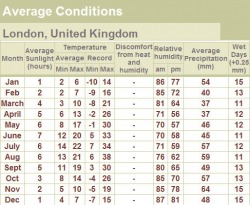
My new home for this school year is inarguably nebulous, according to American Heritage's first definition, and the data proves this out (note in particular the second and far right columns above).
But my home for the rest of my life is nebulous in concordance with the second definition above, that is, a world of immense and deep uncertainty. Though I've come here to LSE in the hope of contributing a bit of order to this environment, I recognize that this massive uncertainty will be a constant going forward - one of few constants, truly.
When I was seven, I believed that adults and experts knew mostly everything. Maybe there were one or two gaps in knowledge that were left unfilled so we could grow up and make our own stamp on the body of human knowledge.
As I approach the state of being grown-up and my friends have become doctors and lawyers and VPs and politicians without getting noticeably smarter, it has become frighteningly clear to me the stuff that we do know is the anomaly and the gaps are the status quo. We know virtually nothing next to what we do not know, small sandy atolls in vast oceans of ignorance.
When I stop to consider it, it blows me away.
A sampling of the things we don’t know includes:
If humanity knows so little, then how little do we as individuals know. And don’t forget, the little we do know is frequently tainted by faulty sensors, leaky data storage and shoddy analysis – e.g. optical illusion, fading memory, egocentric self-delusion. It’s a wonder how we even manage to survive in an objective reality.
We live and will likely continue to live in a perpetual state of incomplete information. Because of this, the phenomena we experience in our lives often appear to be random. Given that life is so short and apparently random, we are all faced with the question: How do we live?
The Nobel Prize-winning physicist Richard P. Feynman once said, "I think it's much more interesting to live not knowing than to have answers which might be wrong." He saw that to live rationally is to operate within the conditions and limitations of uncertainty. This has implications for how we treat our lives and other people.
My thesis is that the optimal strategy in an environment of high uncertainty, advancing digital infrastructure, and growing transparency is trustworthiness. There is an obvious moral foundation, but there is increasingly a cogent economic argument as well. More to come.
neb·u·lous (nby-ls) adj.
1. Cloudy, misty, or hazy.
2. Lacking definite form or limits; vague
[Middle English, from Latin nebulsus, from nebula, cloud; see nebh- in Indo-European roots.]
The American Heritage® Dictionary of the English Language, Fourth Edition copyright ©2000 by Houghton Mifflin Company. Updated in 2009. Published by Houghton Mifflin Company. All rights reserved.
---
My new home for this school year is inarguably nebulous, according to American Heritage's first definition, and the data proves this out (note in particular the second and far right columns above).
But my home for the rest of my life is nebulous in concordance with the second definition above, that is, a world of immense and deep uncertainty. Though I've come here to LSE in the hope of contributing a bit of order to this environment, I recognize that this massive uncertainty will be a constant going forward - one of few constants, truly.
When I was seven, I believed that adults and experts knew mostly everything. Maybe there were one or two gaps in knowledge that were left unfilled so we could grow up and make our own stamp on the body of human knowledge.
As I approach the state of being grown-up and my friends have become doctors and lawyers and VPs and politicians without getting noticeably smarter, it has become frighteningly clear to me the stuff that we do know is the anomaly and the gaps are the status quo. We know virtually nothing next to what we do not know, small sandy atolls in vast oceans of ignorance.
When I stop to consider it, it blows me away.
A sampling of the things we don’t know includes:
- Virtually all that is to come in future eons;
- Nearly all that has happened in the past;
- Everything beyond our physical reach within this vast universe;
- That which is present here and today but permanently out of the scope of our limited senses and understanding—like color to a blind man. Or like a 16-dimensional reality to a 4-dimensional creature. Scientists, keep in mind that the limits of testing are not the limits of inquiry;
- And oh yes, all the things that we could know and capture, and could learn eventually if we made the effort and our species is not extinguished in some future millennia, but happen to not know today. Not a small quantity.
If humanity knows so little, then how little do we as individuals know. And don’t forget, the little we do know is frequently tainted by faulty sensors, leaky data storage and shoddy analysis – e.g. optical illusion, fading memory, egocentric self-delusion. It’s a wonder how we even manage to survive in an objective reality.
We live and will likely continue to live in a perpetual state of incomplete information. Because of this, the phenomena we experience in our lives often appear to be random. Given that life is so short and apparently random, we are all faced with the question: How do we live?
The Nobel Prize-winning physicist Richard P. Feynman once said, "I think it's much more interesting to live not knowing than to have answers which might be wrong." He saw that to live rationally is to operate within the conditions and limitations of uncertainty. This has implications for how we treat our lives and other people.
My thesis is that the optimal strategy in an environment of high uncertainty, advancing digital infrastructure, and growing transparency is trustworthiness. There is an obvious moral foundation, but there is increasingly a cogent economic argument as well. More to come.
 RSS Feed